The work, in the order it ran
1. Read who was on the inventory. Known: the building count, the deadline tiers, the fixed scope. Unknown: why a market with guaranteed demand still behaved like a hard sell. The answer was in who owned the buildings, and it was small landlords, not portfolios with a capital line. What that changed: the problem moved from our capacity to the owner's, and the whole line was designed against the owner's constraint from then on.
2. Test whether the work was bankable. Known: a retrofit adds no rent. Unknown: whether that made it unbankable in practice or only in theory. In practice a conventional lender had no income to underwrite and no upside to secure, and an owner who tried that route came back with nothing. What that changed: financing access, not price, was named as the binding constraint. A financing instrument changes when and out of what an owner pays, not what the work costs, so the price still had to be right; but a right price with no way to carry it converts nobody.
3. Find the instrument built for a no-upside mandated improvement, and put it inside the offer. Known: PACE existed and covered seismic work in the city. Unknown: whether Tellus could originate it or would have to refer owners out, a step where a share of them would simply stop. Certification with Ygrene answered that. What it produced: the decision to enter as a financing-certified contractor rather than one more retrofit bidder.
4. Bundle the engineer. Known: every owner needed an engineer's report before a scope existed. Unknown: whether a second required relationship cost us owners at the point they were most likely to stall. It did, so we paired with a structural engineer and took that errand inside too. What it changed: a fix for the money alone would have left the owner running two errands; the bundle left one. Tellus announced both moves, the engineer partnership in April 2017 and the Ygrene certification in October; the two releases are Attachments C and D.
5. Rebuild intake around the actual gate. Known: scope was fixed by the code and the engineer's report before the owner ever called. Unknown: the smallest set of questions that separated an owner who could move today from one who needed a different path first. The screen that came out of it asks financing questions before scope questions, and it is boxed below.
6. Rank the channels by exclusivity and route every lead through the screen. Known: the city's compliance notices generated the lead list, and the PACE program listed every certified contractor. Unknown: which channel could be structural rather than a head start. A public list any competitor can pull is effort, not structure; the referral relationship with the engineer was the only channel that depended on something a competitor did not automatically have. Leads from all three ran through the same screen, and financing and scope went into one proposal instead of sequential asks.
Everyone in construction read the ordinance as demand. I read it as owners who could not pay.
What it produced: one relationship where there had been three errands
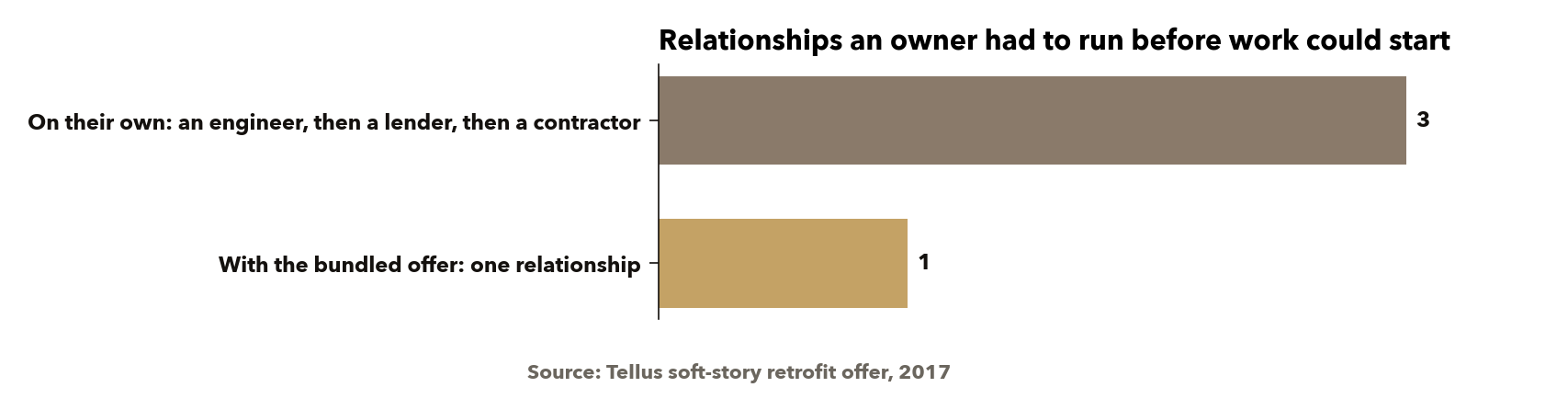
The figure below is the offer in one picture. On their own, a mandated owner had to find an engineer, then find money, then find a contractor, and could stall at any of the three handoffs. With the bundled offer, all three sat in one relationship, and the financing question was answered at the first meeting instead of after the owner had been sent away with a scope and no way to pay for it.
The report's cover figure, behind the gate, carries the arithmetic that makes the premise legible, drawn on one illustrative building so the shape is visible: the cost band a retrofit falls in, the room the PACE program's own caps leave under the assessment on a building of that value, and the added rent a bank could underwrite, which is nothing. Where the cost band sits inside the room under the cap, the assessment can carry the whole job; where a building's value is lower or its mortgage higher, the cap itself becomes the gate, and that is a determination made building by building, which is why the intake screen asks for value and lien position before anything else.
The channels ranked as follows, and the rank is by exclusivity, not by volume.
| Rank | Channel | Who else holds the same lead | What wins it |
|---|---|---|---|
| 1 | Structural engineer referral | Only the engineer, who can now hand a mandated client a financed, ready-to-build offer instead of a scope with no contractor attached | The relationship itself; the one channel here capable of being structural |
| 2 | City compliance notices | Every retrofit contractor in the city, the same list on the same day | Contact speed and message fit; a head start that any competitor working the list can close |
| 3 | The PACE program's contractor directory | Every other certified contractor, since the program's incentive is to list as many as it can | Nothing on its own; an owner arriving this way is comparison shopping |
The six-question intake screen, financing before scope
- Has a structural engineer already issued a retrofit scope for this building, and does the owner have an engineer they intend to keep, or are they open to ours?
- Is the building held by an individual, a small LLC, or an institution with an existing capital budget?
- What is the parcel's value and its existing lien position, and are the property taxes current?
- Has the owner approached a conventional lender about this cost, and what happened?
- Who is the authorized signer for financing tied to this parcel, the owner of record or a manager acting for them?
- Does this owner hold other buildings on the inventory that will need to move through the same process?
Read: a building that clears questions two and three and stalls on four is the owner this line exists for. One that clears four easily has a conventional path and needs the bundle less. The compliance deadline is a lookup against the city's notice and belongs in pre-call prep, not on the sheet. The full screen, with what each answer reveals and the program tests behind question three, is Attachment A.
What we kept, what we replaced, and what we installed
We kept Tellus's design-build delivery as it was, and we kept the engineer's authority over scope, because the code had put it there and there was nothing to gain by re-deriving it. We kept pricing honest against the scope-only bidders working the same engineer's report; the offer's edge was access and speed to a yes, not a discount, and a financed, engineer-paired offer has room to hold its number where a scope-only bidder has nothing to differentiate on but price.
We replaced scope-first intake. Every contractor in the market ran it, and so had we, because it is how you qualify an owner who has chosen to build: square footage, unit count, what they want. It was put in for a customer with discretion. The fault in its logic here was that it spent the first conversation on a variable the code had already fixed and never reached the variable that decided whether the owner could transact. It had to change now because the deadline tiers put a clock on every stall, and an owner sent away to find money was an owner a competitor with financing could pick up.
We installed three things: financing origination inside the firm, through the PACE certification; the structural engineer pairing, so design and construction sat under one relationship before the first lead arrived; and the financing-first screen, so no proposal was drawn for a parcel that could not carry it or for a person who could not sign for it.
What it cost to hold the line, and what I would watch
Holding the line meant walking away from buildings that did not clear the program's tests, where value or lien position would not carry the assessment, rather than taking the job and leaving the owner to work out payment later. It also tied the line to a financing product Tellus did not own. California was actively rewriting PACE's rules in this period; the consumer-protection statutes for residential PACE were signed that October, with ability-to-pay underwriting and state licensing of program administrators to follow, and a contractor whose offer rests on a program's terms inherits every change to those terms. The line's conversion was not measured.
What I would watch is the same thing I would have measured then: originations against permits pulled under the ordinance in the same window, which is the one number that tests whether the financing gap was the binding constraint for most of the inventory or for a minority of it. The mandate economics held either way. A law that creates demand without creating the ability to pay hands the volume to whoever removes the payment constraint, not to whoever prices the obligation lowest, and the volume did come: by 2023 a University of Colorado study put the city's retrofits at about 8,100 buildings and about $1.3 billion of owner spending, on a program that in 2017 was owners stalling in front of a deadline.
The result, in short
Tellus launched the line with 100 percent PACE financing on offer and a structural engineer under the same roof, and every owner was screened on financing before anyone drew a proposal.
A slice of the project list
A few related projects.
- Greensburg, Kansas: a green disaster rebuild funded by category-exclusive sponsors (2007 to 2008)
- Habitat for Humanity: material, bid work, labor and consulting donated to nonprofit housing chapters (2007 to 2016)
- Santa Monica House: a custom home finished through a 2020 crew shortage (2020)